Journal · July 2026 · 6 min read
The aunty, minus the judgment
Bengal kept her ledgers, Punjab sent her between the houses, Kashmir taught her to leave a paper behind — a short history of the Indian matchmaker, and of the half of her the websites threw away.
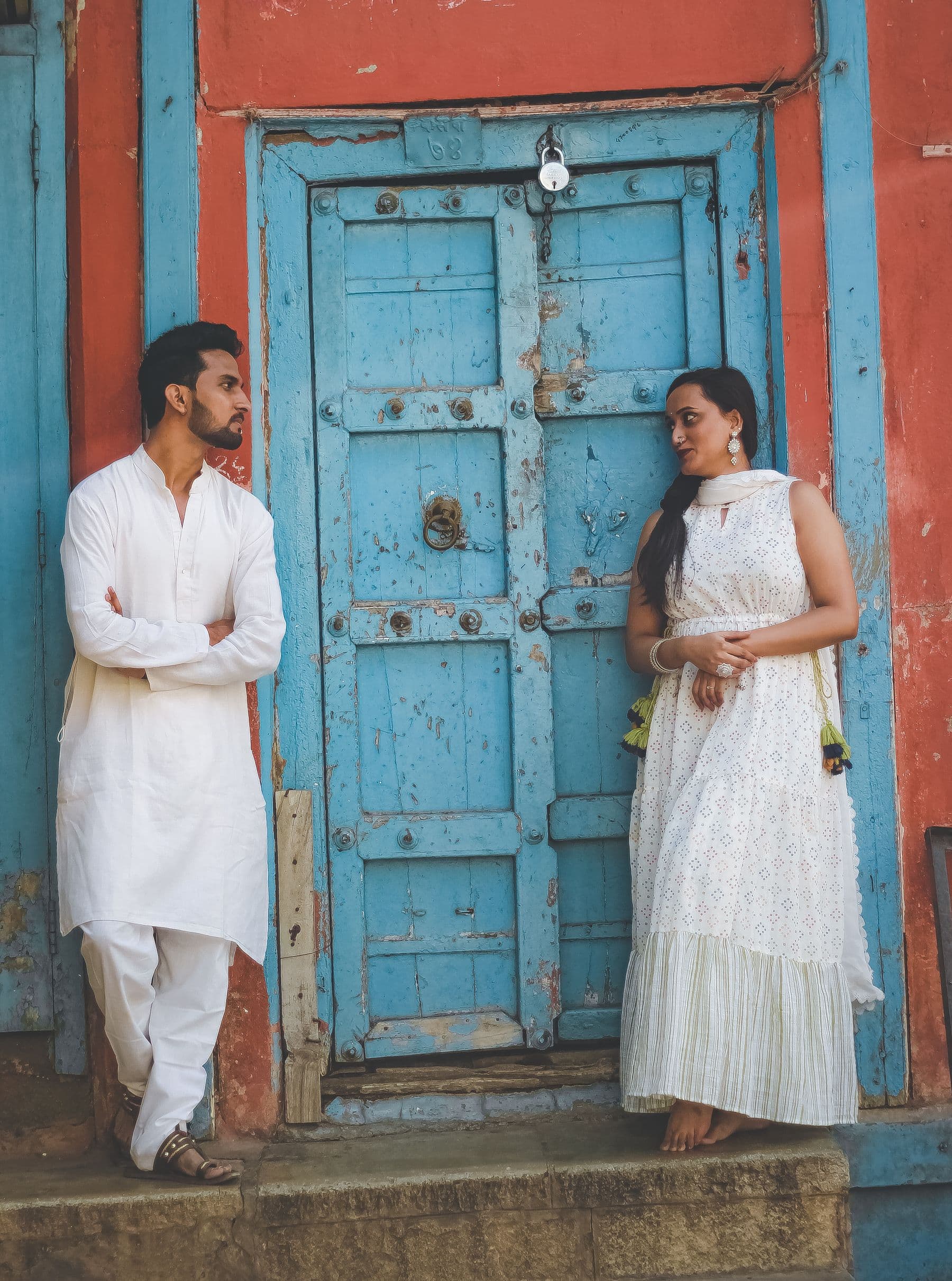
Before there was a grid of faces, there was a person. Every region of the subcontinent built the same institution and gave it its own name. In Bengal, the ghotok. In Punjab and across the north, the vichola, with the barber and the barber’s wife carrying word from one household to another. In Kashmir, the manzimyor. The brief was identical everywhere: in a society where unmarried young people could not simply meet, someone had to know both families well enough to say, with their own name behind it, these two should talk.
The names she went by
Bengal kept the best records. Banglapedia, the national encyclopedia published by the Asiatic Society of Bangladesh, describes the ghotok — ghatak, in its spelling — as a professional intermediary in a society where young men and women had no sanctioned way to mix. The scholarly ones, called kulacharya, “used to maintain books with detailed histories of families” — genealogical ledgers so thorough that historians still treat them as source material. The trade had names that outlived their centuries: Edu Mishra and Hari Mishra in the thirteenth, Dhruvananda Mishra and Devivar Ghatak in the fifteenth, Nulo Panchanan in the eighteenth. Banglapedia records that ghotoks “used to enjoy a great deal of social prestige” — and that they took fees from both parties, paid when a match was made.
Look at what that arrangement contains. A body of carefully kept information. A person whose own standing rose and fell with the quality of their introductions. Payment on outcome, not on attention. A thirteenth-century Bengali matchmaker was better aligned with the people she served than most subscription software is today.
In Punjab and across north India, the role split in two. The vichola was “a mediator between the families who provides the full information about the socio-economic status of the family,” as a 2022 paper in IJCRT puts it, while the barber and the barber’s wife — welcome in every courtyard by trade — customarily carried proposals between households. Writing in Outlook in 2024, Vineetha Mokkil describes this traditional go-between as most often a family friend or a relative playing a neutral part. Scout and negotiator, in other words: one to know who had come of age in which house, and one to say the delicate thing so that neither family had to.
Kashmir gave the trade its most beautiful artifact. The manzimyor — manzimyarin when she was a woman — profiled candidates and left their details, in writing, with families she judged compatible, a custom Gyawun’s guide to Kashmiri weddings records as parché traavun: leaving the paper. An introduction that arrived as a document — considered, written down, left with the family to weigh in its own time.
She never left
None of this is safely in the past tense. In December 2016, Open Magazine ran Lhendup G Bhutia’s profile of Umesh Patel, marriage broker to Mumbai’s Gujarati Kapol community. His method reads like a service manual: screen the candidates, run the background checks, arrange the meeting, take the debrief afterwards. Asked to explain what he actually sells, Patel said this:
“I enter my clients’ veins, deep, inside, to understand what sometimes they themselves don’t know.”
That sentence is the whole profession. Not filtering — knowing. A filter tells you who clears the bar a family has set; the knowing tells you which two people, out of everyone who clears it, might actually build a life. And the debrief matters as much as the introduction: a broker who calls both sides after the meeting learns things no form will ever hold, and carries them into the next attempt. His files grow wiser. A database only grows longer.
The profession still has an audience, too. When Netflix’s Indian Matchmaking made a Mumbai matchmaker a global celebrity in 2020, Bengali commentators recognised the ghotok on sight, as The Business Standard observed. The show travelled because the role translates: every culture has a version of the person who knew everyone, and most of them miss her.
What the websites kept
Then the industry arrived. Over the last two decades, the matrimonial platforms took the matchmaker apart and kept the cheaper half. Her ledgers became searchable databases — the kulacharya’s books scaled to millions of rows, filterable by every preference a family could name. That half industrialised beautifully. The other half — the judgment — did not survive the porting. No one on a platform knows both families. No one’s name is on the introduction. No one calls the day after the first meeting to ask what was said, and what was felt. The filters, which carried the old prejudices, were automated and multiplied. The knowing, which was the entire value, was quietly deleted.
To be fair to the platforms, scale was the point, and the scale is real — they put millions of strangers within reach of one another, which no ghotok’s ledger ever did. But reach was never the scarce thing. Judgment was. So the modern seeker inherits the strangest of both worlds: the gatekeeping of the old system with the loneliness of the new one. A grid that sorts people by the categories an aunty would have used, with none of the aunty’s ability to look at two particular people and see it.
The half we kept
Talkiepoint is an attempt to run the same trade in the opposite direction. We keep what the ghotok, the vichola, the manzimyor and Umesh Patel all carried. Judgment — introductions made by understanding people, not by matching rows. Accountability — a named founder answerable for the standard behind every introduction, whose standing, like the ghotok’s, depends on being right. And the written reason — every introduction arrives as a note that says who, and why, in words you can weigh. Our version of parché traavun, left with you, decided by you.
And we drop the half the platforms chose to scale: the sieve of birth and background. Our application doesn’t ask, and we don’t sort by it. The aunty was always two people — the one who guarded boundaries, and the one who understood hearts. We are keeping the second, along with her books, her name and her paper. The first has done quite enough.